Born in Beijing in 1954, Zhu Jinshi moved to Germany in the mid-1980s, and at present lives and works in Beijing. Zhu began painting abstract works in the late 1970s, and participated in the Stars group exhibition, the first avant-garde art exhibition held after the Cultural Revolution. The core of Zhu’s artistic practice is most fittingly characterized by traditional Chinese aesthetics, which emphasises the harmony between human beings and the natural world.
Part of the legendary generation of artists who left China in the 1980s, Zhu Jinshi was clearly marked by his move to another country and culture. He used contemporary Western art languages to find the contemporary possibilities in the cultural resources and materials of China.
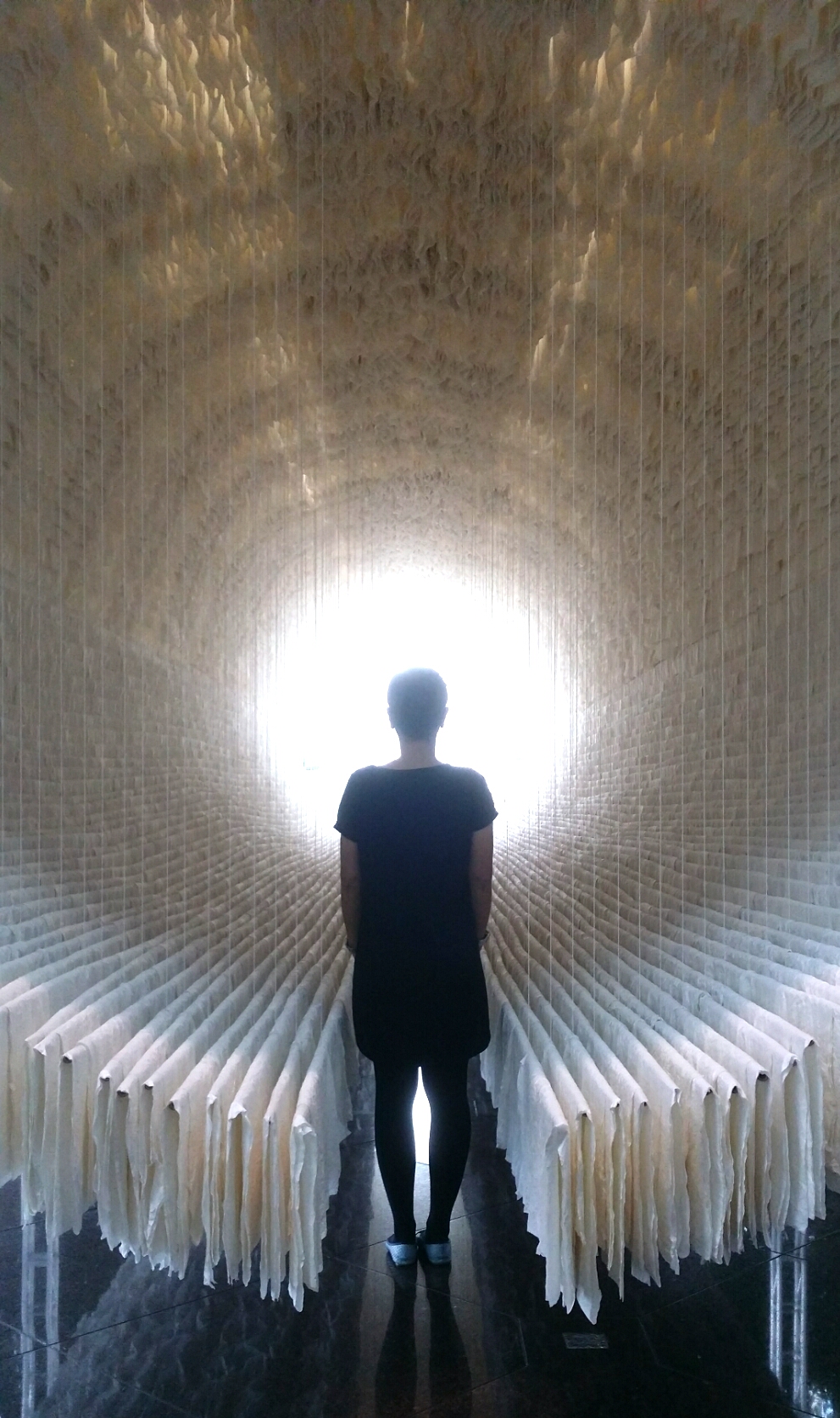
At Exchange Square in Hong Kong, visitors are immediately greeted by Zhu Jinshi’s monumental Boat. Bamboo, cotton and 8,000 sheets of pale white Xuan (rice) paper meticulously hang from the ceiling, forming a spherical tunnel and stopping just before touching the ground. “I used materials, thoughts, and traditions of the East as a tool to go against the power of West-Centrism,” Zhu says.
Using Xuan paper—a material laden with Chinese history and tradition—Zhu creates a symbolic representation of a boat. But more than a boat, the 12-meter long installation also represents a journey. “He challenges the audience to think,” says Zhu’s gallerist, Pearl Lam. ” Why do you have to walk into this boat? Because whenever you walk in you feel very spiritual. It’s like an enlightenment.”
When moving through the installation, the outside world is quieted. Noise is muted, and light is dulled. One’s movement through the tunnel becomes a representation of a boat’s journey, of the drifting and mixing of cultures.
“Globalization is manufacturing a homogenous culture, and this makes people think about cultural identity,” Lam explains. “For him, sculpture and installation are very Western, so he is [trying] to bridge between the West and Asia.”
Rather than a logical analysis, summarization or expression of individual emotions, the artist characterizes his work as “mind images” produced by the complete comprehension of a given phenomenon. He believes that his perception and understanding of the world can be fittingly expressed only through sustained contact and dialogue with materials. It is through this process that these materials act as vehicles for his inner spirituality.
The Rotunda, Exchange Square, Central, Hong Kong
Presented by Pearl Lam Galleries and Hongkong Land, 09 March 2015 – 31 March 2015, Monday to Sunday, 9 am – 7 pm
 Gαlαtēe & Co